
Sex Offender Checks in Liberty County
The Texas Public Sex Offender Registry is the main official search for Liberty County. DPS receives data from local registration authorities and publishes the information allowed by Texas law. The search supports name and location modes, including county, city, address, and ZIP filters. A result should be opened and read, not reduced to a map marker.
Local authority depends on residence. A person living inside an incorporated city ordinarily registers with city law enforcement. Someone outside a city registers with the applicable county authority. That split means the Liberty County Sheriff's Office does not necessarily handle every city registrant. Contact the listed local authority when a status or address needs verification.
How to Search the Texas Public Sex Offender Registry
Choose the search mode that matches what is known. A name query works best when identity is the question. An address or county search supports neighborhood awareness. Spelling and geocoding affect results, so repeat a location search with a city, ZIP, or broader county filter if the first attempt is blank.
- Open the Texas DPS registry and select a name or location search mode.
- Enter the known name, address, city, ZIP, or select Liberty County.
- Review the list or map and compare the available identity and location details.
- Open the full profile and read its address status, verification, offense, duration, and local authority information.
| Field or control | Type | When used | Notes |
|---|---|---|---|
| Search By | Tabs/options | One mode | Name, address, higher education, or location modes may appear |
| Last name | Text | Name mode | Follow the portal's partial or exact-name guidance |
| First name | Text | Optional | Narrows a name search |
| Address | Text | Address mode | Street, city, and ZIP quality affect the map |
| City or ZIP | Text/dropdown | Optional | Use Liberty, Cleveland, Dayton, or another place |
| County | Dropdown | Optional | Select Liberty |
| Radius and map/list | Controls | Location mode | Read live distance choices without assuming a range |
The official Texas DPS registry search screen provides the visual context for these fields.
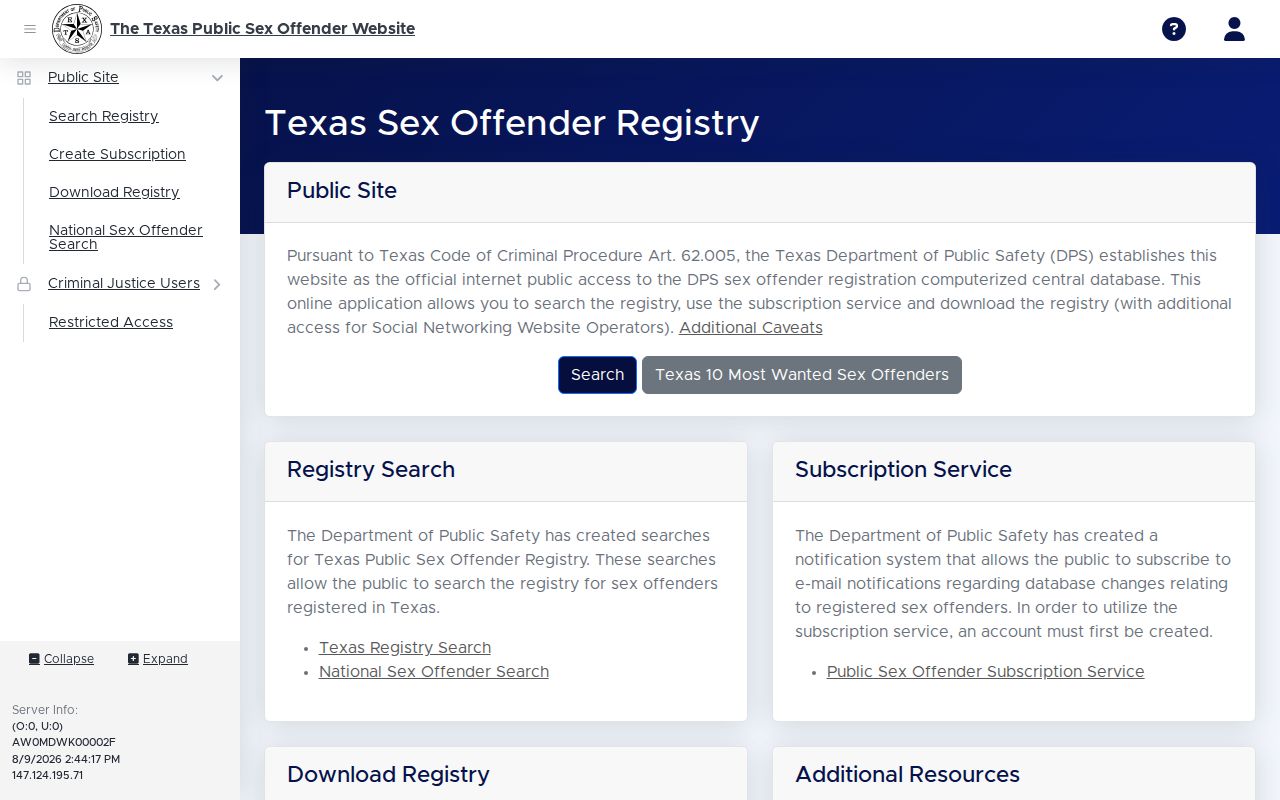
The portal also offers subscriptions and notifications through a DPS Crime Records account, which can help track a defined area over time.
Liberty County Registry Address Gaps
A location search depends on the address being current and capable of geocoding. Transient status, incarceration, a recent move, or noncompliance can change what the map displays. A pin may be approximate. It is not a boundary survey or permission to enter private property.
If an address will not map, broaden the search to city, ZIP, and Liberty County. Try the name mode when identity is known. Read the profile's status and verification fields. Then contact the local registration authority if a material inconsistency remains. A blank radius result is not proof that no registrant is nearby.
Transient, incarcerated, moved, and noncompliant labels require special care. They describe status, not an invitation for private follow-up. Save the profile link and the exact concern, then give it to the authority that can check nonpublic registration data. A resident should never try to verify an address by approaching the listed household.
Note: Liberty County location results support awareness, but address quality and registration status can affect how accurately a profile appears on the map.
Inside a Registry Profile
A public profile combines identity, location, registration, and offense information that Texas law permits DPS to release. Read each label carefully. Risk level concerns notification assessment, while registration duration follows a different part of Chapter 62. Some fields collected by agencies remain confidential.
| Name and aliases | Public identity names plus DPS or state identifiers where released. |
|---|---|
| Photo and description | Current public photograph and physical traits such as height, weight, hair, and eyes. |
| Address or status | Registered location or another location/status description with verification and compliance indicators. |
| Reportable offense | Offense, statute, conviction or disposition date, court, and jurisdiction where public. |
| Risk level | Low, moderate, or high assessment where assigned; not the registration duration. |
| Other public data | Marks, tattoos, vehicle details, or higher-education association when law makes them public. |
| Nonpublic fields | Victim identity, Social Security number, driver-license data, private phones, and other confidential details. |
No private person's profile or photograph is reproduced here. The official DPS record remains the correct source for current identity and status information.
Offense information may include the reportable offense, statute, court or jurisdiction, and a conviction or disposition date. Some profiles can include a victim age or sex category where Texas law makes it public, but never a victim's identity. Vehicle information, scars, marks, tattoos, and higher-education associations appear only when collected and publicly authorized.
Liberty County Registry Field Limits
Texas agencies collect more information than the public page displays. Employer details, online identifiers, personal phone numbers, driver-license information, Social Security numbers, victim-identifying data, and confidential DPS fields are not ordinary public registry content. Juvenile registration can also be exempted, deferred, or made nonpublic by a court.
The Texas DPS registration program overview explains the registration and notification system.
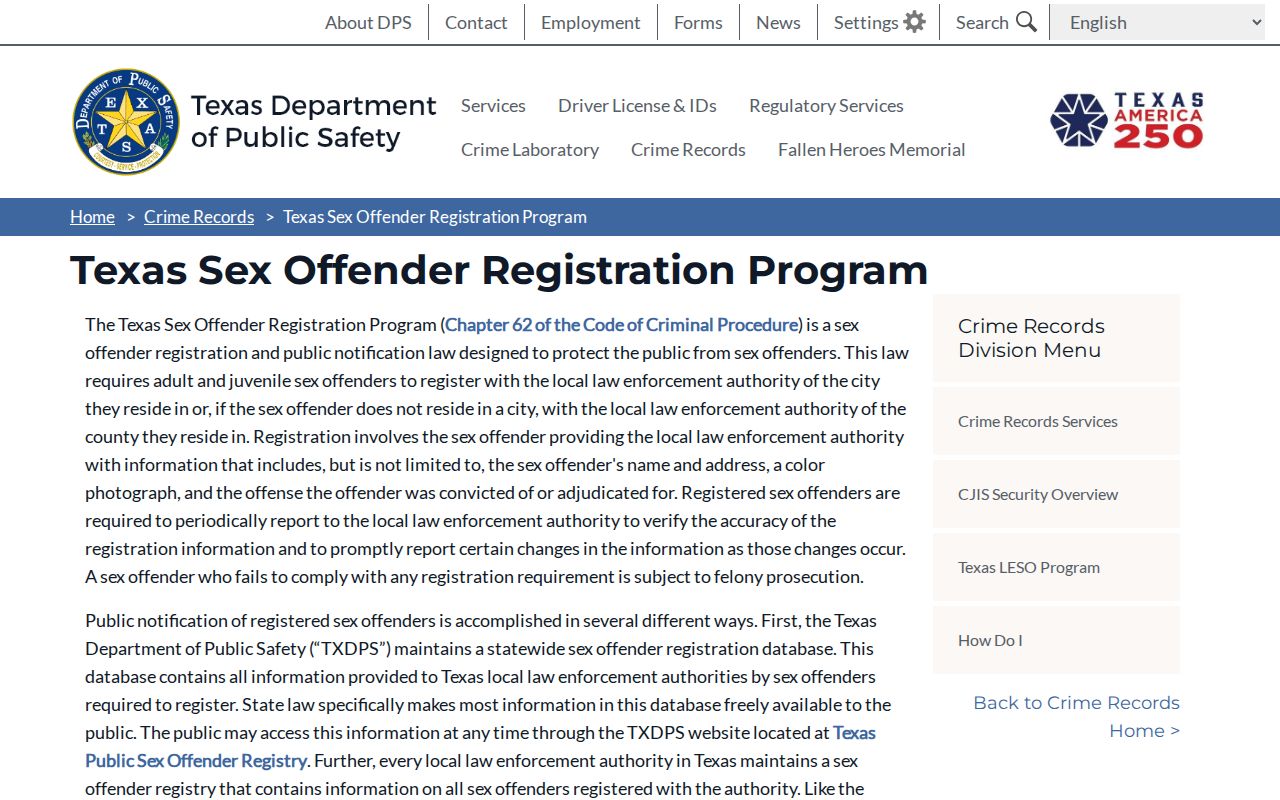
The program page helps separate what local law enforcement verifies from what DPS publishes. A public record can be useful while still omitting data protected by statute.
Texas Registration Levels and Requirements
Texas does not use the federal Tier I, II, and III labels as a simple public duration schedule. Adult registration generally lasts ten years after release from confinement or discharge from supervision, or lasts for life, depending on the reportable offense and history. Low, moderate, and high risk labels are notification assessments, not duration tiers.
| Texas category | Duration or treatment | Public meaning |
|---|---|---|
| Adult non-lifetime offense | Ten years after release or discharge, as Chapter 62 calculates | Duration comes from offense and statutory rules |
| Sexually violent and other lifetime categories | Lifetime | Confirm the exact Chapter 62 category |
| Repeat reportable history | Often lifetime | Exact subsection controls |
| Juvenile registration | Court and statute specific | May be exempted, deferred, or nonpublic |
| Risk level | Low, moderate, or high | Notification assessment, not duration |
Verification frequency can depend on the person's statutory category and status. Contact the responsible local authority rather than assigning a schedule from a federal tier label.
Duration begins from the point Chapter 62 specifies, often release from confinement or discharge from community supervision or parole, rather than simply the conviction date. Repeat reportable convictions can lead to lifetime treatment under statutory categories. Juvenile duties are court and statute specific, so an adult duration chart should not be applied to a juvenile case.
Liberty County Registry Notifications
DPS explains that a high-risk registrant or a civilly committed sexually violent person moving into a community can trigger English and Spanish postcard notice to nearby homes and businesses. Local authorities also notify schools when Chapter 62 requires it. The statewide portal can support public subscriptions through a DPS account.
Notification is one layer of safety planning. It does not predict conduct, and a risk label does not measure the chance of an offense at one exact address. Use the information with ordinary safety steps, current local guidance, and accurate identity matching.
Public subscriptions through a DPS Crime Records account can monitor a defined area, but an alert still requires careful reading. Postcard or electronic notice may reflect a move or updated record rather than a new offense. Compare the date, address status, local authority, and profile details before drawing a conclusion.
Note: Texas risk level guides aspects of notice, while the reportable offense and statutory history determine how long registration continues.
Liberty County Registry Beyond Texas
Use the National Sex Offender Public Website when a search crosses a state or county line. NSOPW queries participating jurisdictions after the user accepts its conditions. It supplements the Texas registry rather than replacing DPS or the local registration authority.
The official NSOPW search interface shown below is the proper cross-state layer.
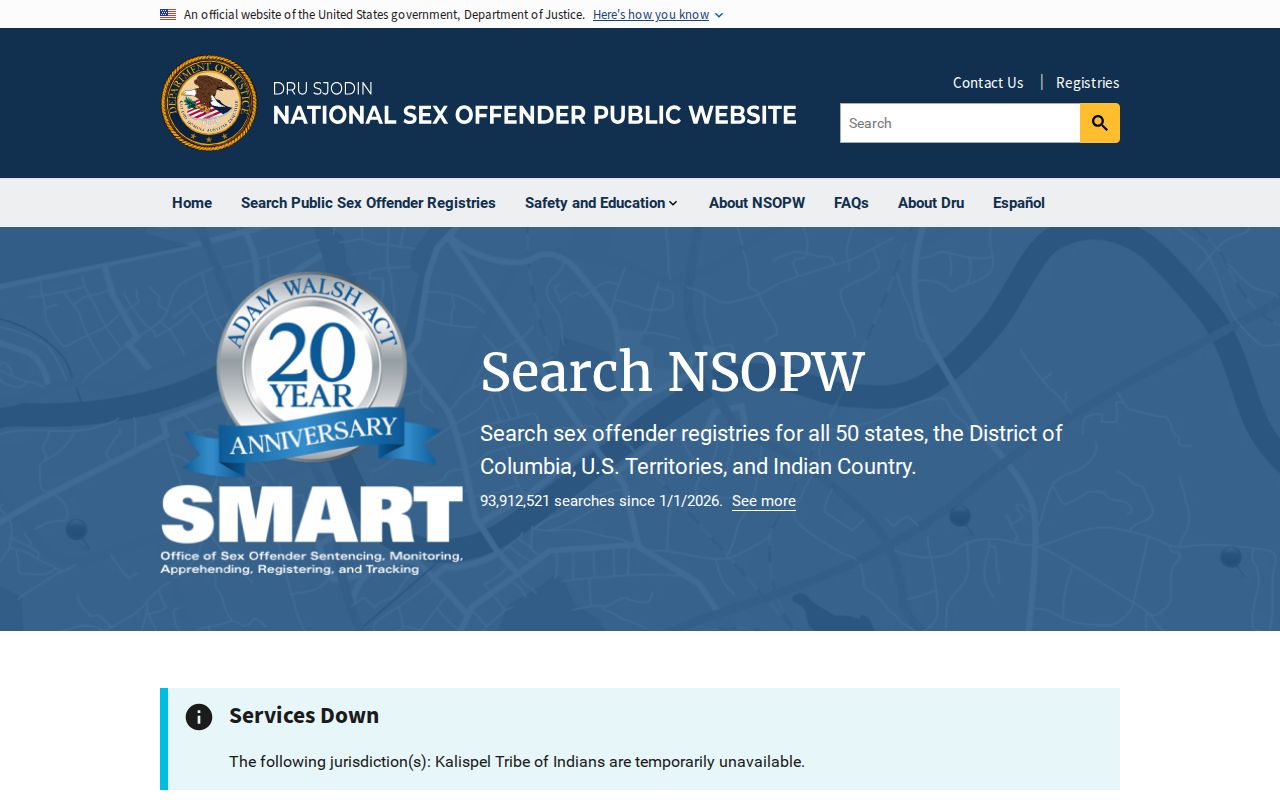
Compare any national result with the originating jurisdiction's profile. A negative DPS or NSOPW search is not a safety guarantee, and differences can reflect timing, participation, status, or how an address was entered.
Community Notification and Lawful Use
Registry access supports personal, family, and community awareness. It does not authorize contact, retaliation, public shaming, or private enforcement. If a profile appears noncompliant, record the concern and contact the local registration authority or law enforcement. Officers can compare the report with information that is not public.
Misuse warning: Texas Code of Criminal Procedure Chapter 62 governs registration and public notice. Registry data does not authorize harassment, threats, vigilantism, trespass, intimidation, or other criminal conduct. Misuse can expose the actor to criminal penalties under applicable Texas law.
Never confront a registrant or household. Do not assume that a listed address creates a right to enter property, photograph residents, or distribute sensitive details. Read the DPS conditions of use and verify the profile before relying on a name or map match.
When reporting a possible discrepancy, state what field appears wrong, when the profile was checked, and which address or status caused concern. Law enforcement can determine whether the information is current, delayed in transmission, exempt from public display, or evidence of noncompliance.