
Liberty County Criminal Court Cases
Liberty County divides adult criminal files by charge level. The 75th and 253rd Judicial District Courts hear felonies, and the District Clerk keeps those files. County Courts at Law handle Class A and Class B misdemeanors, with the County Clerk serving as custodian. A Class C citation or city-ordinance matter may remain in a municipal or justice court, so it can be absent from the county criminal portals.
Both clerk systems center on the Liberty County Courthouse at 1923 Sam Houston Street. The split matters because a sheriff report, a booking record, and a filed case are separate records. The court file begins when a charging instrument is filed. It then grows through docket entries, motions, hearings, pleas, and the judgment. To follow the earlier custody event, compare it with the county arrest lookup process.
District Clerk
Room 115, 1923 Sam Houston Street
Liberty, TX 77575
936-336-4682
County Clerk
1923 Sam Houston Street
Liberty, TX 77575
936-336-4670
Liberty County iDocket Search
The Liberty County District Clerk directs the public to iDocket for district records and tells users to tag Liberty as the primary county. Search by Name is free. Display Case and Advanced Search can require subscriber access. Vendor help says the data is extracted daily, yet a newly filed item can still be missing from the screen.
The District Clerk page is also the source for the district-record route shown below. Its screen is a starting point, not a certificate that no case exists.

The image ties the portal to the office that can answer coverage questions and locate older or unindexed Liberty County criminal case records.
Vendor help documents more detail than the free landing search. Advanced controls can include state, county, civil or criminal category, case type, court, litigant role, Soundex, attorney role, filing dates, and disposition dates. A free result may show case number, case type, style, filing and disposition dates, court, parties, attorneys, and bondsman data. Subscriber history can organize motions, orders, citations, other actions, costs, payments, and a ledger. Those screen labels still do not replace a filed document.
Searching Liberty County Case Records
Start with the strongest identifier available. A cause number is more precise than a common name, while a court and filing range can narrow a broad result set. Read each count and disposition separately. One charge may be dismissed while another ends in conviction or deferred adjudication.
- Open iDocket and select or tag Liberty County.
- Search by cause number when known, or use the full party name and reasonable spelling variants.
- Narrow the results by criminal category, court, case type, or filing date.
- Open the docket and compare filing date, court, charge, status, and disposition.
- Contact the District Clerk for felony copies or the County Clerk for misdemeanor copies and certification.
| Field | Type | Required | Use |
|---|---|---|---|
| County | Dropdown | Yes locally | Select Liberty County |
| Case number | Text | No | Best match when known |
| Party name | Text | No | Try full legal name and variants |
| Court | Dropdown | No | Narrow to district or county court |
| Case type | Dropdown | No | Choose criminal where offered |
| Filed from/to | Date | No | Limits the date range |
Note: An empty online result does not prove that Liberty County has no older, sealed, restricted, or newly filed case.
Liberty County Misdemeanor Dockets
The county publishes free, daily-updated misdemeanor docket links on its Criminal Court page. A docket is a schedule or event list, not the whole file. It can help confirm a setting and court, but it may change as matters are reset, resolved, or moved. The posted warning also says a failure to appear may result in a warrant.
The official county criminal docket page shown here separates docket access from payment and copy services.
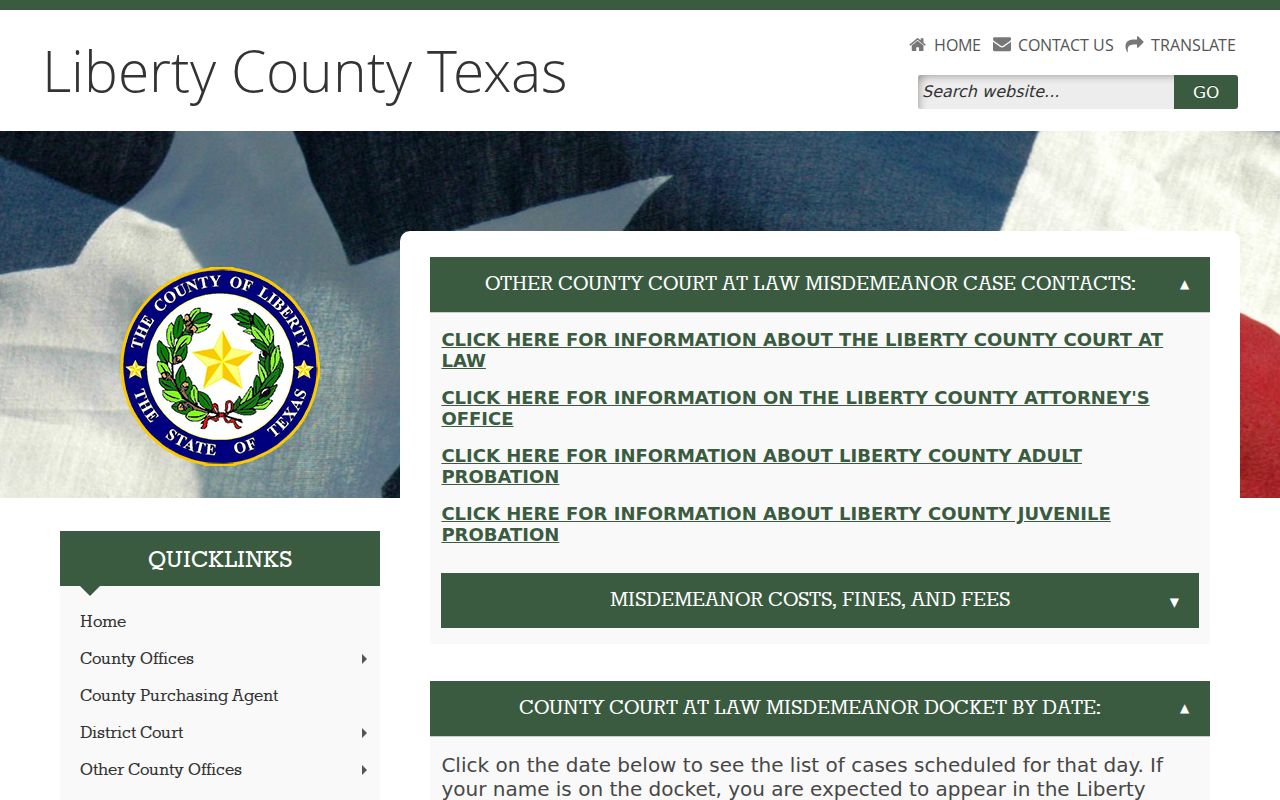
Use the current docket to confirm a hearing, then ask the County Clerk for the filed record when proof of the outcome is needed.
The published 2026 county-court calendar also retains in-custody dockets on Tuesdays and Thursdays at 1:30 p.m. A calendar provides scheduling context, not proof that a case was heard or resolved. Check the live docket and court file for changes, resets, pleas, or judgments.
Inside a Liberty County Case File
A Liberty County court file is organized around one cause number. It may show several counts, each with its own charge and result. Online views can summarize events without displaying every document. The clerk's record remains the source for a certified judgment, order, or charging instrument.
| Cause number and court | Identifies the case, trial court, filing date, type, and pending or disposed status. |
|---|---|
| Charging instrument | Shows the complaint, information, or indictment and the offense class alleged in court. |
| Parties and counsel | Lists the State of Texas, defendant, and attorneys, with protected identifiers omitted. |
| Docket events | Records filings, bond, settings, motions, pleas, orders, warrants, and appeals. |
| Disposition and judgment | States how each count ended, including dismissal, acquittal, conviction, or deferred adjudication. |
| Sentence and costs | May list confinement, community supervision, fines, costs, credit, and public conditions. |
Birth data, financial identifiers, victim information, and juvenile material may be redacted or withheld. Never infer restitution, guilt, or a current warrant from a field that the file does not actually show.
Certified Liberty County Court Copies
Certified misdemeanor copies are not digital Texas Public Information Act requests. The County Clerk's misdemeanor page tells requesters to call 936-336-4670 to arrange payment and pickup. Posted county copy charges are $1 per page plus $5 certification per document. Felony copy questions go to the District Clerk in Room 115.
The County Clerk page pictured below is the source for that critical distinction.
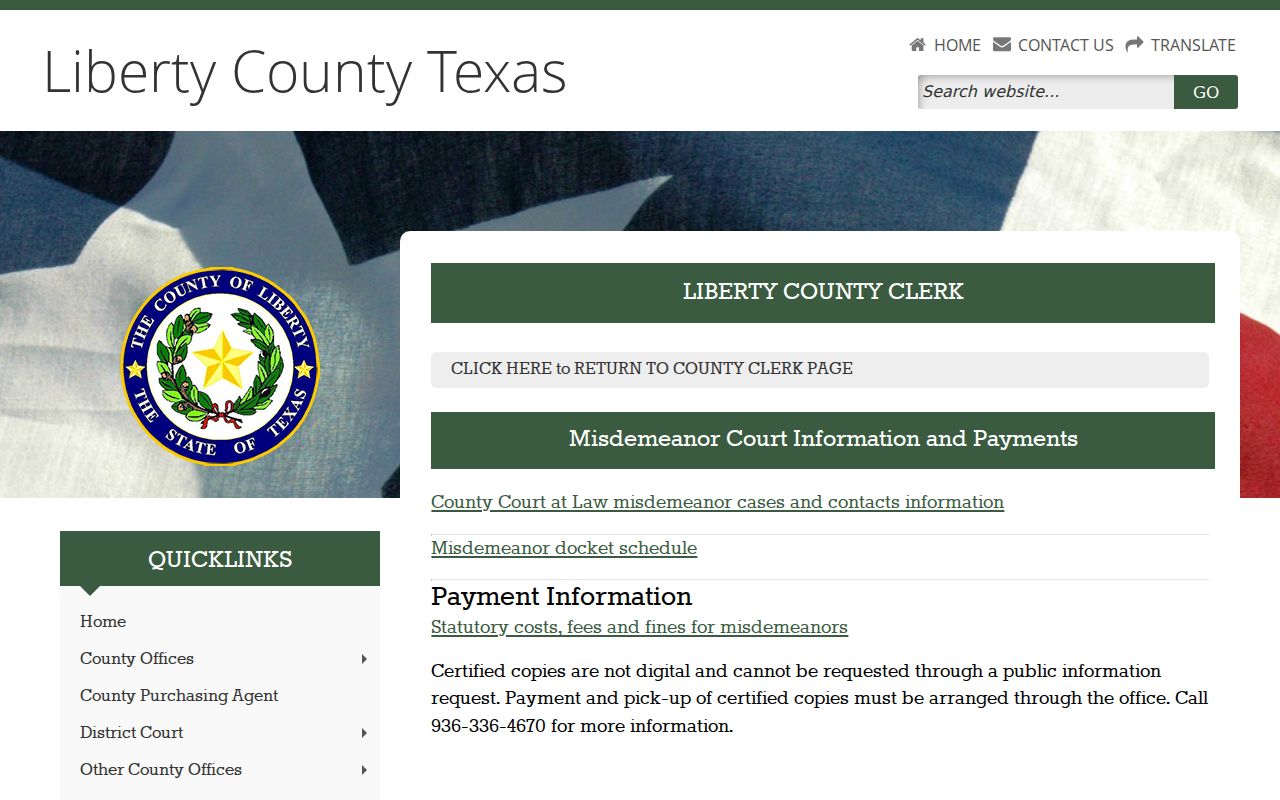
State the cause number, court, document name, and whether certification is required. That keeps a request focused and avoids confusing a payment portal with record access.
Transcript requests follow a different route. The 75th and 253rd District Court pages require a written request that identifies the case style, hearing date, desired portions, and exhibits. The 75th describes full prepayment, while the 253rd describes a deposit based on half the estimate. A reporter's transcript is distinct from the clerk's docket, judgment, and certified copy, so ask for the exact record needed.
How a Liberty County Case Moves
A felony may begin with a complaint and magistration before a grand jury considers an indictment. A misdemeanor generally proceeds by complaint and information. The filed charge can differ from the arrest charge, which is why the final court disposition must be read count by count.
Case flow: Charges Filed › Arraignment › Pretrial › Plea or Trial › Disposition › Sentencing
Arraignment is the stage when the accusation is presented and a plea is taken. Pretrial entries may reflect discovery, motions, settings, or a negotiated resolution. A judgment records the legal result, while sentencing records the penalty or supervision terms. Post-judgment motions and an appeal can add later events without erasing the earlier docket.
Note: A booking description is an initial allegation, while the Liberty County charging instrument controls what the court was asked to decide.
Liberty Cases and re:SearchTX
re:SearchTX is useful as an e-filing-based cross-check, but it is not a complete statewide criminal-case search. The Texas Judicial Council's 2024 report said criminal case records were excluded from its large document and case collection. Do not treat a blank statewide screen as proof that Liberty County has no criminal filing.
The statewide re:SearchTX interface pictured here provides context for its limited cross-check role.
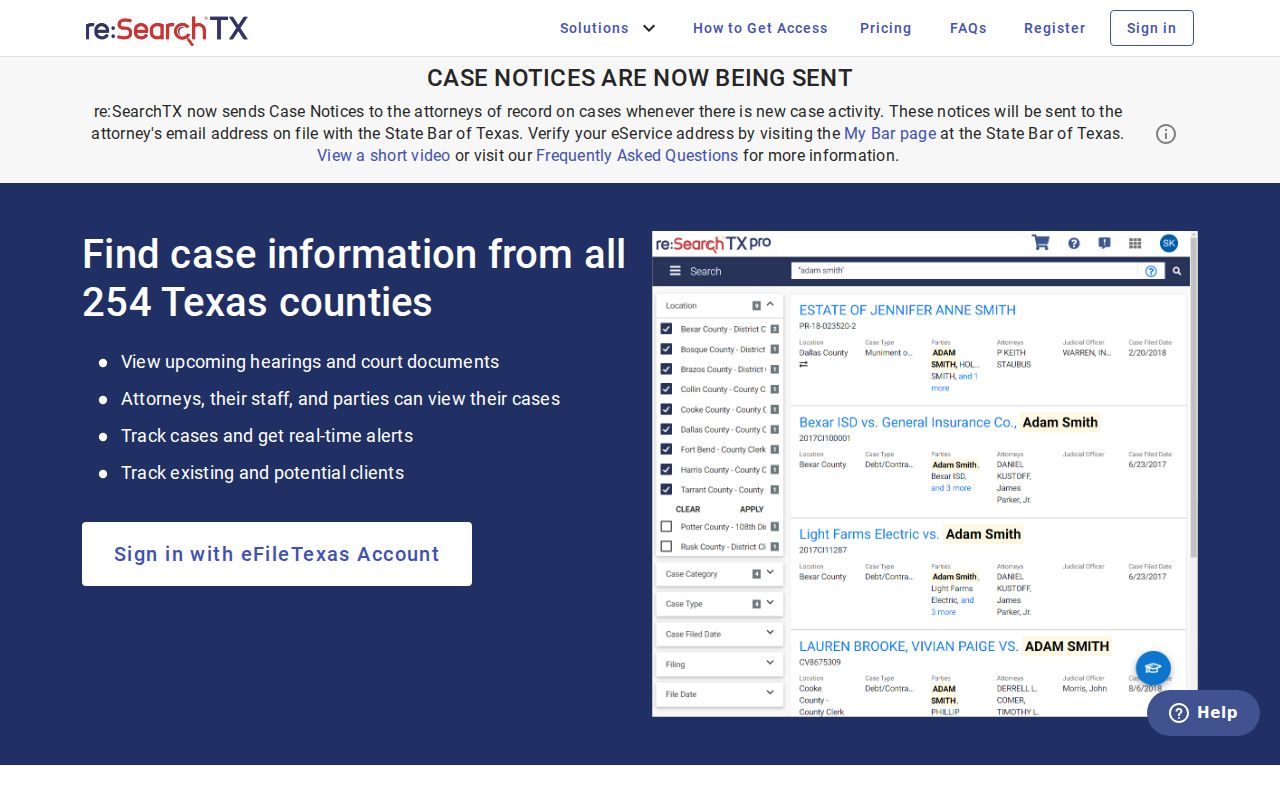
Use iDocket, the daily misdemeanor docket, and the correct clerk as the local chain. The official Tyler Odyssey Judicial Records and Jail Bond Records portal is another county-linked channel, but its live fields could not be verified because automated access returned a 403 response.
Liberty County Filed Charge Changes
The arresting agency names an offense at the custody stage. The prosecutor can reject it, amend it, file a different charge, or present a felony to a grand jury. A no-bill means the grand jury did not return an indictment. A nolle prosequi is the prosecutor's formal choice not to continue a charge. Neither term should be mistaken for a conviction.
- Disposition
- The result of a charge or case.
- Deferred adjudication
- A plea or finding is deferred during community supervision; it is not an acquittal.
- Capias
- A court order directing an arrest, often tied to a court event or judgment.
- True bill
- A grand jury's return of a felony indictment.
The Liberty County District Attorney prosecutes felonies, while the County Attorney handles Class A and B misdemeanors. That prosecutor split tracks the district-clerk and county-clerk split.
The official District Attorney page reinforces which office is tied to felony case development.
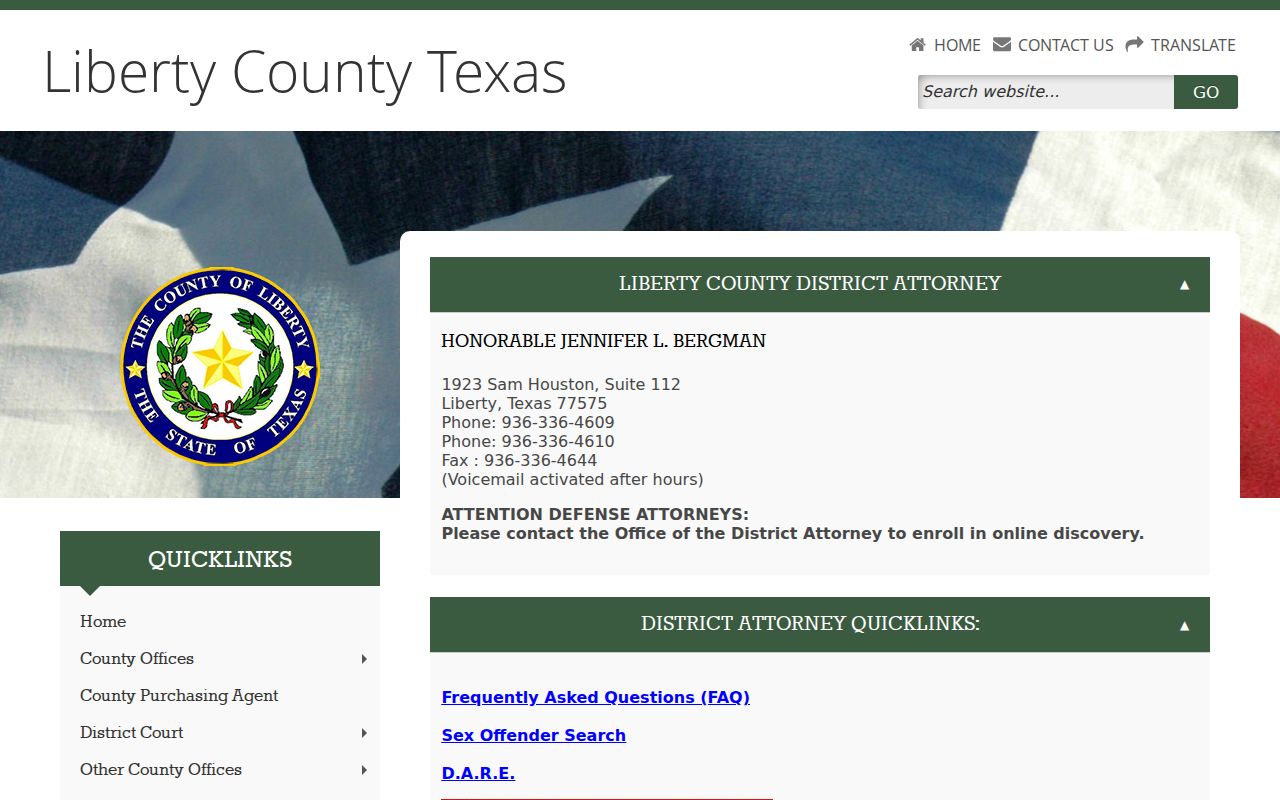
For the result, rely on the court's docket and judgment rather than a press item or initial booking label.
Case Record Access & Restrictions
The Texas Public Information Act governs many agency records, but court files are obtained from the clerk under court-record access rules. Sealed matters, juvenile records, victim or minor data, Social Security numbers, financial identifiers, and protected driver information may be absent or redacted. Online access can be narrower than counter inspection.
When the index fails, contact the clerk that owns the file. Give the party name, approximate filing year, court, and cause number if known. Older material may require a manual search. County records may be viewed without charge during regular business hours, and a written felony-record request can be directed to the District Clerk at the courthouse. A certified copy must come from the clerk, not iDocket or a general public-information portal.
The iDocket landing page illustrates the vendor layer used for Liberty County district searches.

Identity and outcome should always be checked against the originating Liberty County court file before a name match is treated as reliable.
A nondisclosure order can restrict ordinary public release while preserving access for specified government purposes. Expunction can direct removal, destruction, or return of qualifying records. Juvenile restrictions operate under a different legal framework. Each condition can explain why a once-visible Liberty County case no longer appears through an ordinary public search, and none should be guessed from a blank screen alone.