
Checking Criminal History in Dayton
Start at city level when the event involved a Dayton officer or a city citation. The police report, municipal case, county booking, filed prosecution, and DPS history answer different questions. Use an exact name, date of birth when lawfully requested, approximate date, location, and any report or citation number. Keep the search narrow enough that staff can locate the right Dayton record.
- Call Dayton Police at 936-258-7621 to identify the report and confirm whether the department holds it.
- Submit a focused public-information request through the designated City Secretary channel for the incident material.
- Search Dayton Municipal Online Services for a city citation, traffic matter, ordinance case, or related warrant.
- Check Liberty County booking and clerk channels if the matter became a Class A or B misdemeanor or felony.
- Use the Texas DPS public name search for reported Texas convictions and deferred adjudications, or FAST fingerprints to review your own fuller record.
Dayton Criminal Record Request Route
Dayton designates its City Secretary as the formal intake point for requests under the Texas Public Information Act. The official choices are the city's public-records request route, delivery to City Secretary at 117 Cook Street, or email to citysecretary@daytontx.org. The city warns that a message sent to another employee, a department account, or social media does not trigger the formal process. That detail matters when a Dayton request concerns police records but must enter through the city's stated channel.
The form asks for first and last name, any represented company or firm, mailing address, city, state, ZIP, email, phone, a description, signature, and request date. It also offers email or hard-copy delivery. A driver's-license field appears but is not marked as required in the research. Describe the record by incident number, date, location, parties, and type, such as offense report, call sheet, photo, or video. Dayton says that if the records cannot be produced within ten business days, the city will certify a reasonable production date. That statement is not a guarantee of delivery within ten days.
Crash reports take a different route. Dayton directs users to the Texas Department of Transportation's CRIS system for the official crash-report search and purchase channel.
Dayton Police Department Records
Dayton Police creates the incident or arrest narrative when its officers respond. The department's nonemergency number is 936-258-7621. A Dayton police record can include the service number, date and location, alleged offense, involved parties, officer information, and public portions of the narrative. It is not the same as a jail intake sheet or a court disposition. Ask the department to confirm the report number before filing a request when the number is unknown.
Texas law can require redaction or withholding of active investigative information, juvenile information, victim details, driver's-license data, and other confidential fields. A precise request can reduce review time and cost. For video, identify the date, approximate time, location, and involved person as specifically as possible because body-camera requests have added statutory identification rules.
Note: No verified official Dayton police app with an app-only records feature was found, so avoid unofficial lookalike applications.
Dayton Annex Criminal Record Boundaries
The Dayton annex at 1300 West Clayton is useful, but its offices do not form one criminal-record counter. Justice of the Peace Precinct 4 can be reached at 936-258-2461, Constable Precinct 4 at 936-258-4711, and the Sheriff's Civil Division at 936-258-2036. County Clerk and tax services also operate there. Each office keeps records tied to its own legal duties.
The most common mix-up is treating the Sheriff's Civil Division as the place for a Dayton police report. Civil process is not the police records unit and is not the county jail. A city incident request belongs with Dayton's designated city route. A JP case belongs with that justice court. A county booking question belongs with the sheriff or jail. A filed Class A or B misdemeanor belongs with the County Clerk, while a felony file belongs with the District Clerk at the Liberty courthouse.
Geography reinforces the confusion. Dayton lies on the U.S. 90 corridor, while the central courthouse, sheriff headquarters, and jail are in Liberty. The annex offers a closer county contact for several tasks, but it does not move central felony custody away from the District Clerk or turn a precinct office into a city records unit. Calling the named custodian before a trip is the safest way to avoid reaching an office that can only redirect the request.
Dayton Arrests and Bookings
A Dayton arrest begins with the arresting agency's report, but continuing custody may be recorded elsewhere. Dayton Police may transport a person for county or contracted custody. The county's jail compliance operations mean the city of arrest, booking authority, and physical confinement site can differ. Do not assume every person arrested in Dayton remains at the Liberty jail building.
For current custody, contact the Liberty County Sheriff or jail and provide the person's identifying information. The booking file can show intake time, arresting agency, initial charge, bond, holds, and release or transfer status. The Dayton police report supplies the incident narrative. If prosecution follows, a clerk creates a third file. The Liberty County arrest lookup explains the broader county sequence.
An arrest entry may appear before a prosecutor decides what to file. The arrest charge can change, and a jail record may remain even after release. Always read the later court outcome before describing the result.
Searching Dayton Municipal Records
Dayton's official Municipal Online Services search is the direct web channel for city court matters. It accepts several identity paths: citation number plus date of birth; driver's-license number, issuing state, and date of birth; Social Security number and date of birth; vehicle plate and issuing state; first and last name with date of birth; or business name. The Search button runs the query, and ordinary use did not visibly require a login during research.
The official Dayton court search is shown below. It illustrates the city-level lookup that should be checked separately from Liberty County court portals.
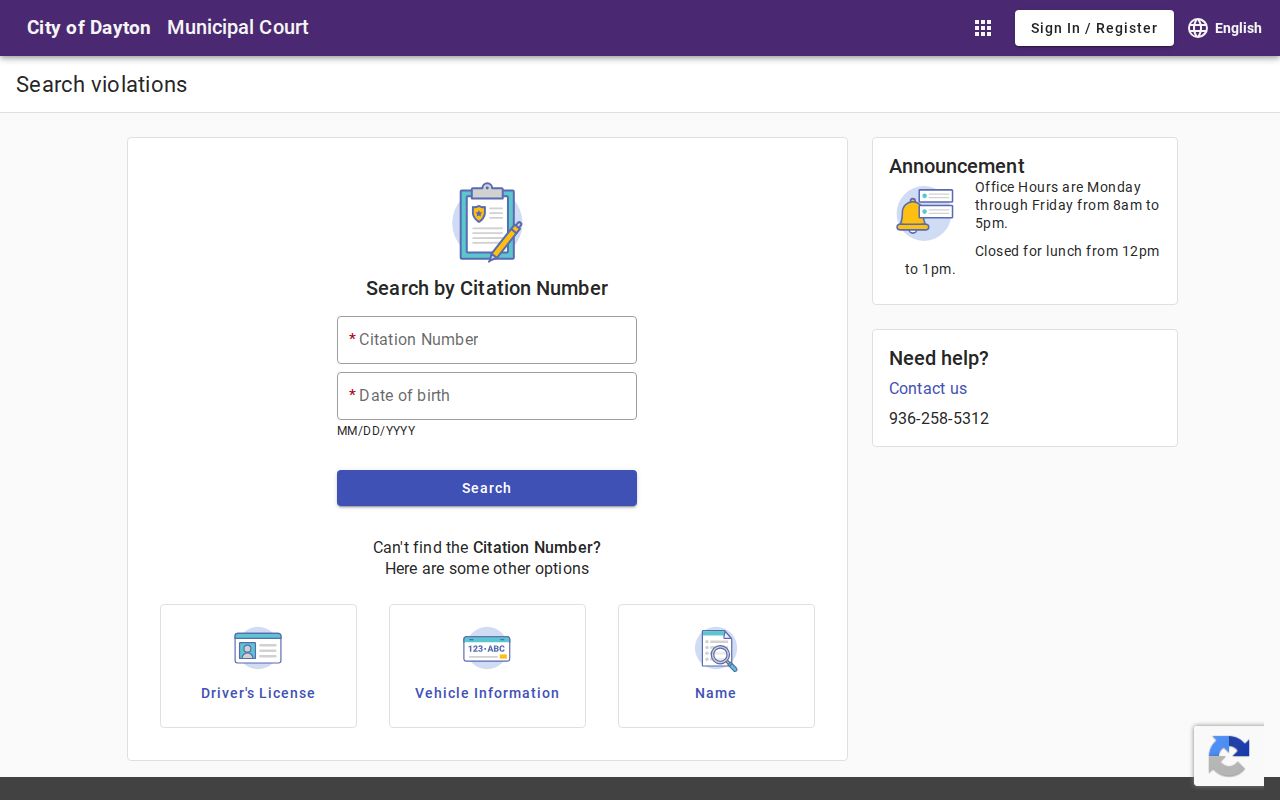
A no-result screen can mean the criteria are wrong, the matter belongs to another court, or the record is not available through that interface. Try the citation number when known, verify the spelling and birth date, then call the court rather than treating an empty search as a clean-record finding.
Municipal Court Records in Dayton
Dayton Municipal Court is at 2002 North Cleveland Street and can be reached at 936-258-5312 or court@daytontx.org. Posted hours are Monday through Friday, 8 a.m. to 5 p.m. Its jurisdiction is fine-only and city level, including municipal ordinances, many traffic citations, and Class C matters. It does not replace the county courts that hear Class A and B misdemeanors or district courts that hear felonies.
| Court Name | Dayton Municipal Court |
|---|---|
| Case Types Heard | Fine-only city ordinance, traffic, and Class C matters |
| Case Lookup Channel | Municipal Online Services, court email, phone, or clerk counter |
| What the Docket Shows | Identity-linked citation or case information, status, amounts, settings, and warrant information where available |
| Copies & Fees | Ask the municipal clerk for the current copy method and charge; no local copy fee was verified in the research |
Dayton Criminal Warrants After FTA
A missed Dayton citation setting follows a city process. The court says it mails a Last Warrant Notice with a new date. Continued failure to appear can produce a warrant and entry in a statewide police database. That municipal warrant may not appear in Liberty County's felony or misdemeanor case portals because the originating court remains Dayton Municipal Court.
The court lists cash, credit card, cashier's check, money order, online payment, and a phone payment line at 855-784-9212, but no personal checks. Its published plan describes $100 down and $100 monthly payments, requests for community service based on indigency, and an added 30 percent collection fee after 60 days. Confirm the live balance and status directly with the court before acting. Payment information is not a substitute for verifying that a warrant has been recalled.
A municipal failure-to-appear entry also differs from a county capias. The issuing Dayton court controls its own citation warrant, setting, payment options, and recall. A county court or district court controls a capias tied to its cause. When a name search shows a warrant without enough context, identify the issuing court and citation or cause number before contacting any payment channel. That step prevents a city matter from being mistaken for a separate county prosecution.
Where Dayton Records Go
A serious Dayton matter can move through several systems. Dayton Police creates the report. County or contracted custody creates booking data. The County Attorney may file a Class A or B misdemeanor, while the District Attorney handles felony prosecution. The County Clerk or District Clerk maintains the resulting case, and a reportable disposition can later join the DPS criminal-history cycle.
Record flow: Dayton PD › Liberty County Courts › Texas Department of Public Safety
For recent activity, check the city report and custody channel first. For a filed result, read the appropriate clerk record. DPS's public name search covers reported Texas convictions and deferred adjudications, not every arrest. A person reviewing their own fuller identity-based record should follow the DPS FAST fingerprint process.
Dayton Criminal Cases by Level
The legal grade determines where the record belongs. Dayton Municipal Court handles fine-only and city ordinance cases. Liberty County Courts at Law handle Class A and B misdemeanors. The 75th and 253rd Judicial District Courts hear felonies, with the District Clerk as custodian. A city citation number therefore should not be forced into a district-case search.
Charge labels can change as the case moves. The offense listed at a Dayton arrest reflects the officer's booking basis. A prosecutor can reject it, file a different grade, or present a felony allegation to a grand jury. The clerk's file shows the charge actually filed and the outcome count by count. When a booking and court screen conflict, use the signed judgment or dismissal order rather than treating the earliest label as final.
| Record question | Dayton starting point | Next layer |
|---|---|---|
| Police incident narrative | Dayton city request | None unless another agency created related records |
| Traffic, ordinance, Class C | Dayton Municipal Court | Ask the court about appeal or warrant status |
| Class A or B misdemeanor | Liberty County Clerk | County court docket and certified copy |
| Felony charge | Liberty County District Clerk | 75th or 253rd District Court file |
Dayton Record Matches and Identity
Name-based systems can return the wrong person or miss a record because of spelling, aliases, and incomplete dates. Dayton's municipal search offers more than one lookup key, so start with the citation number when available. For county cases, a cause number is stronger than a name. Compare court, filing date, charge, and disposition rather than relying on a matching name alone.
The DPS public search costs credits and is still name based. It is designed for publicly disseminable reported convictions and deferred adjudications. FAST fingerprints serve a different purpose: reviewing one's own fuller Texas identity record and challenging errors. Neither product replaces the Dayton police narrative or municipal docket.
Note: A record that belongs to someone with a similar name should be reported through the source agency's correction process.
Public Access Rules in Dayton
The Texas Public Information Act governs access to public information held by Dayton, but it does not make every police detail public. The city may redact confidential information and may seek an Attorney General ruling when withholding information without a prior determination. Court records follow clerk access and sealing rules. DPS criminal-history disclosure has its own limits, and reporting law explains why local events can later reach the state repository.
Key Statutes:
Texas Public Information Act, Government Code Chapter 552 - provides access to public information while allowing statutory withholding and redaction.
Texas Government Code Chapter 411 - limits DPS criminal-history disclosure while authorizing public conviction and deferred-adjudication information.
Texas Code of Criminal Procedure Chapter 66 - governs reporting of arrest, prosecution, disposition, and custody events to the state system.